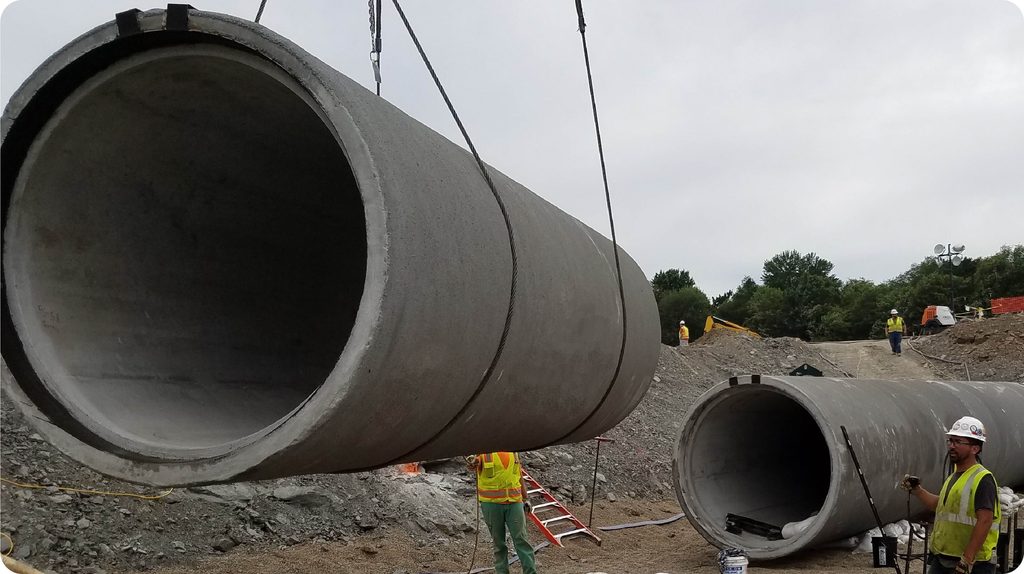
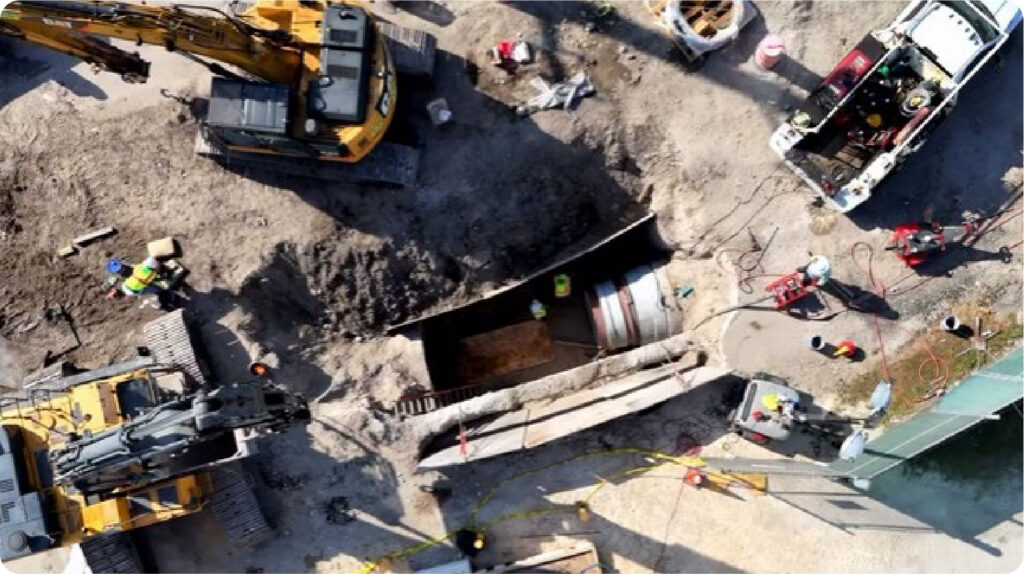
Few pipe materials in the pressure pipe market have a track record as long as prestressed concrete cylinder pipe (PCCP), which has carried water for North American utilities for more than 80 years. Over that time, its performance has been proven in service, and the standard it is built to has been continually strengthened. Because of this long history, utility owners and engineers sometimes ask about pipe made during the 1970s, and how it compares with pipe made today. Since 1979, the AWWA C301 standard for PCCP has been revised to strengthen requirements for materials, manufacturing, testing, and quality control.
Design Standard
- AWWA C304 Design Standard is introduced. The introduction of a new design standard did not mean old designs were inadequate, as the existing design approaches were conservative, but it did change the design approach from the semi-empirical appendix A and a working stress model appendix B designs in AWWA C301 to a limit states design which included multiple combinations of serviceability limits, elastic limits, and strength limits. -1992
Steel Cylinder
- Requires a minimum thickness for steel cylinders of 16-gauge – 1992
- Allowance for use of cold-rolled steel was eliminated. This was added to ensure separation between yield strength and ultimate strength of cylinder steel. – 1999
- Added qualification requirements for welders and welding operators. This was added to ensure performance quality of welders welding on pipe and fittings. – 1984
- Added a requirement for testing cylinder weld strength. This was added to ensure weld quality of weld seam on cylinders. – 1992
- Minimum allowable tensile strength was raised. -1992 (33ksi) and 2014 (36ksi).
Concrete Core
- Specific gravity lower limits are set for aggregates along with minimum testing frequency- 1992
- Mandatory hot weather concreting requirements are included -1992
- Concrete creep and shrinkage tests are now required. – 1992
- Maximum limit for water-cement ratio has been established for concrete pipe core. -1999
- A guideline for collecting concrete samples for test cylinder was established. – 1999
- In no case shall any concrete core cylinder tested fall below 80% of the required strength. – 2014
Prestressing Wire
- Wrapping tension – more closely controlled – 1984
- Slurry application rate during prestressing is specified – 1992
- Tests to discriminate against wire with longitudinal splits – 1988
- Torsion test requires necking and full shear break, perpendicular to wire axis – 2004
- Mechanical tests performed on samples from every coil of wire – 1992
- Wire relaxation test is added – 1992
- To eliminate detrimental strain aging and the potential for hydrogen embrittlement
- Maximum wire drawing temperature limits are established -1992
- Torsion tests are mandated – 1984
- Upper tensile strength limits are established – 1984
- Wire with visible pitting, or rust which cannot be wiped off, is prohibited from use in pipe – 1988
- The minimum size wire which can be used is increased from 8-gauge to 6-gauge – 1992
- Strength test requirement for wire splices has been added – 1999
- Verification of the required tension level in case of wire breakage in the middle of wire wrapping – 2014
Mortar Coating
- Increased minimum mortar coating thickness. -1984
- Increased minimum moisture content. This increases density of mortar. – 1984
- Testing of mortar moisture content. – 1992
- Testing of mortar coating absorption and a reduction of allowable absorption. This improves coating by making it less permeable. – 1992
- Minimum mortar coating compressive strength. – 1992
- Non-destructively checking mortar coating thickness on every pipe. This ensures adequate coverage over steel. – 1992
- Checking the cured mortar coating for soundness on every pipe. This ensures mortar is properly impacted over wire and ensures no voids or hollows. – 1992
- Specifications of slurry cement content and application rate for mortar coating and prestressing operations. Slurry encapsulation of wire was added to ensure no voids in haunches of wire and ensures an alkali environment around wire. – 1992
- Tolerance added for mortar coating thickness (+/- ½”) – 2014
Gaskets, Fittings, Specials and Test Equipment
- Specifications for gaskets, fittings and specials and test equipment have all been improved. Gasket splice strength and storage requirements were established, and additional equipment calibration checks are included. – 1992
- Requirements for mortar lining and coating for fittings have been modified extensively. – 2014
Annual Quality Audits
- As a part of ACPPA’s Compliance Audit and Certification Program, every concrete pressure pipe production facility is audited annually by LRQA. The audit ensures quality and continuity of manufacturing practices. The audit was developed by consensus by the North American concrete pressure pipe (CPP) industry to ensure compliance to the specific, applicable standards for concrete pressure pipe. The compliance audit consists of over 200 confirmations of operational and quality practices. -1984
Together, these changes mean today’s PCCP is built under far tighter controls than pipe produced in the 1970s. To learn more, visit our C301 PCCP page. For questions about PCCP design, performance, or condition assessment of existing lines, please reach out through the contact form on our Concrete Pressure Pipe page.
Further Reading:
https://thompsonpipegroup.com/explosive-pccp-myths-busted/